
Autonomy needs shared strategy and a decision owner
Source 06:30Peter Sellis's advice in this interview starts with the cost of coordination. Collaboration can improve a decision, but making everyone participate in everything also consumes time. A team that shares a strategy and knows who has responsibility for a decision can act without repeatedly reconstructing alignment.
That puts a different burden on leadership: make the strategy sufficiently clear for people to apply it, then give the responsible person room to work. A collection of meetings cannot substitute for that clarity. Nor does autonomy mean that every person independently chooses a different destination.
Sellis's comments about product management follow the same logic. He questions whether the role adds enough value to justify its coordination cost in every situation. That is a challenge to demonstrate contribution in a particular team, rather than evidence that every organization should remove PMs. The useful question is what decisions and outcomes improve because the person is there.
Exceptional strengths need a suitable environment
Source 11:41Sellis describes people whose abilities are unusually strong in one area and uneven in others. His discussion of Nikita illustrates why treating every talented person as an interchangeable manager can waste the very skill that made the person valuable.
He compares backing someone to continuing to believe in a band after a disappointing album. One weak result does not erase the evidence of unusual ability. The management task is to distinguish that case from a poor fit and create conditions where the strength matters.
This is a judgment about people and context. It does not provide a rule that a high performer should be excused from every responsibility, or that one style of leader works in every organization.
Monetization is constrained by the product people use
Source 21:14The Snap discussion makes the consequences of product structure concrete. A camera-first experience creates content rather than presenting an obvious feed slot for an advertisement. Messaging serves a different purpose from browsing entertainment. A younger audience can also create restrictions around targeting and measurement.
Sellis acknowledges that camera monetization did not work as hoped. The point of the example is not that every surface can be made into a successful advertising business if a team tries hard enough. The audience's purpose and the available interaction shape the opportunity.
Subscriptions have their own time dimension. People may need to form a habit and accumulate reasons to pay before a subscription proposition becomes attractive. Comparing cohorts without considering how long they have used the product can obscure that development. Revenue cannot be understood by inspecting a price or an upgrade screen alone.
Systems thinking should produce an explicit model
Source 30:20For Sellis, systems thinking means identifying stocks, flows, variables and distributions, then making assumptions explicit enough to inspect. A spreadsheet can force that discipline: what changes, what accumulates, and how does one quantity affect another?
The value is in exposing a model to disagreement. If a proposed growth initiative assumes a particular conversion rate, retention pattern or supply constraint, the team can discuss that assumption rather than argue over the phrase “systems thinking.”
A model is still an approximation. Making an assumption visible does not make it true, but it gives the team something to test and revise when reality differs.
Product taste includes the good work you decline to ship
Source 35:03Sellis compares product work to curation. A museum is shaped by selection, not by displaying everything that could fit inside. Similarly, a product can have well-made prototypes that should remain unshipped because they do not belong in the experience.
That is a stronger standard than removing only features that lose an A/B test. A polished idea may still create complexity, distract from the product's purpose or consume attention that should go elsewhere. Taste appears in what the team deliberately leaves out as well as what it launches.
AI makes this problem more acute when it lowers the cost of producing features. More feasible options increase the need to choose. Faster construction does not settle whether a feature deserves a place in the product.
Advertising requires a view of future trust
Source 40:30In discussing possible advertising in conversational AI, Sellis treats relevance and user trust as parts of the product decision. Selecting only the highest bid can conflict with what a user wanted from the conversation. The immediate auction result is not the whole economic outcome if the experience damages future use.
These are his design arguments about such a system, not a verified account of any company's current implementation. Their broader application is to ask what the monetization mechanism rewards and how that reward interacts with the user's reason for returning.
A team needs a view of the longer-term effect, even when the short-term revenue is easier to measure. Otherwise an apparently efficient local choice can weaken the product that creates the advertising opportunity.
Attention to strong performers has a management cost too
Source 47:23Sellis advocates spending substantial time with people who are doing well: give them more responsibility, support their work and defend them publicly when appropriate. Leadership attention can amplify an existing strength rather than always being allocated to the most visible problem.
He also acknowledges a limitation in his own approach: coaching people who are struggling has not been his strength, and that can frustrate others. That admission matters. The interview does not demonstrate that struggling employees never deserve help or that a manager's lack of attention proves someone is failing.
The practical tension is allocation. A manager has to decide where attention changes outcomes while recognizing what their preferred style leaves underserved.
Core growth starts with the experience for existing users
Source 50:56Sellis's Snap and Discord examples resist the assumption that the next audience is always the most promising source of growth. At Snap, improving the Android experience mattered after the 2018 redesign. At Discord, he describes renewed attention to gaming and the ways people connect before, during and after play.
The reasoning is that a product with a strong existing purpose may still deliver that purpose inconsistently. Performance, reliability and depth can matter more than a new use case. A prominent community or fashionable application can attract attention without explaining the behavior of the broader core audience.
Retention and engagement should therefore be examined in terms that match the product. Different ratios and time windows answer different questions; a frequently used aggregate engagement ratio should not be casually treated as the probability that an individual returns the next day.
Expansion can follow an adjacent strength or an imagined future
Source 58:09One route to expansion is to inspect cohorts and unexpected workarounds. Users may already be stretching a strong product to do something adjacent. That behavior gives the team evidence about a problem and an existing advantage it can extend.
Sellis distinguishes this from imagining a desired future and working backward. That can produce a more discontinuous idea, but it requires a different creative judgment. Neither method is a guarantee, and improving the core does not make a business immune to every external change.
Keeping the distinction clear helps a team state what kind of bet it is making: extending observed behavior, or attempting to create a future that is not yet visible in current usage.
Long-term revenue can require a short-term sacrifice
Source 70:57Sellis uses “long-term greedy” to describe attention to advertiser return on investment. Helping an advertiser succeed today can support retention and larger future budgets. Maximizing the amount collected immediately can work against that relationship.
He does not pretend the trade-off is painless. Revenue pressure is real, and a decision that protects future value may look worse in the current period. The principle asks the team to make that trade-off consciously rather than assume that every near-term increase represents durable progress.
Core product value needs both a sentence and measurements
Source 73:27Sellis describes core product value as a connection between a meaningful promise and metrics. For Snap, he breaks the promise into speed, sharing a moment and the people one cares about. For Discord, the purpose centers on talking and hanging out around games, including before and after play.
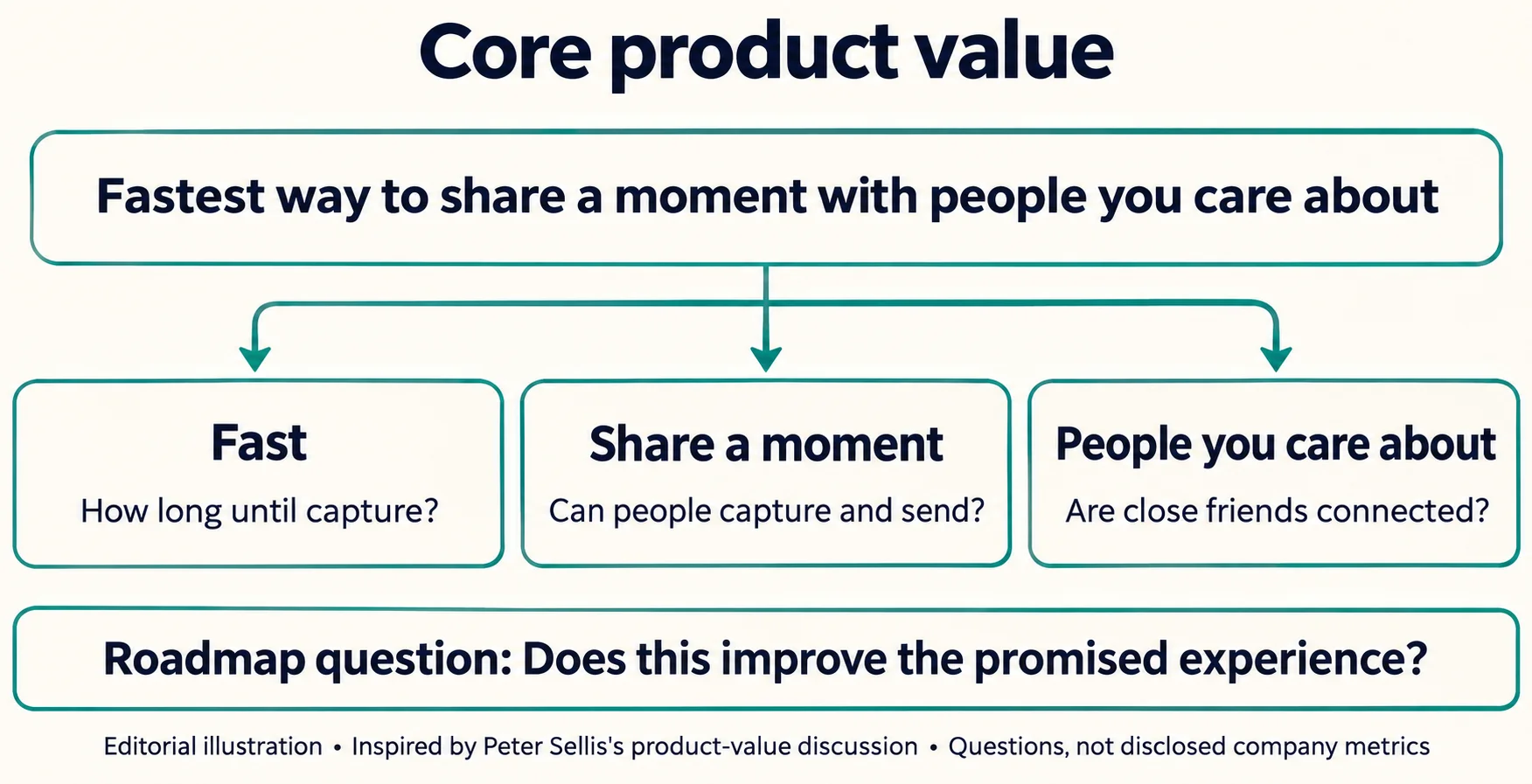
A phrase alone can be inspiring but fail to guide work. A number without a connection to the purpose can be precise but meaningless to the team. The task is to choose observations that show whether the promised experience is actually happening; the interview does not disclose a complete internal metric specification for either company.
That connection gives a roadmap discussion a concrete test. Does a proposed change improve the experience described by the promise, and what evidence would show the improvement? It also helps identify a feature that is easy to build but unrelated to the reason people came.
Product leadership involves opposing demands
Source 76:39Sellis closes his substantive advice with pairs of qualities that need to coexist. A PM needs conviction while remaining open to being wrong, organization while tolerating ambiguity, and urgency while thinking beyond the immediate period. Giving others credit has to coexist with owning a decision.
Those tensions explain why a checklist of isolated virtues is insufficient. The role requires deciding which demand matters in the situation and noticing when a strength has become an excess. A clear purpose, explicit assumptions and visible outcomes make those judgments easier to discuss with the team.