
Recognizing persuasion changes the meaning of a message
Source 04:07Kent Grayson begins the substantive discussion with persuasion knowledge: the understanding people develop about being influenced and the techniques used to influence them. He explains it as a knowledge structure, like other categories people acquire through experience.
It is not active all the time. Someone may initially treat a recommendation as ordinary information, then recognize a commercial motive. That recognition changes how the message is evaluated. An influencer's sponsorship disclosure or an unusually scripted recommendation can bring the persuasion attempt into focus.
Grayson calls attention to the change in meaning rather than assume its direction. The model does not require every recognition of advertising to produce distrust. Understanding that someone is persuading us can help us distinguish among different persuaders and techniques.
Distrusting a category is not the same as distrusting every member
Source 07:59The hosts ask about surveys in which advertising is distrusted as a whole. Grayson does not dismiss a well-conducted category survey, but says variation within a category can be just as important to a marketer.
People may say they distrust the media while trusting the outlet they choose, or distrust politicians while trusting a particular representative. Similarly, a person can be skeptical about advertising in general yet receptive to a brand or a persuasive method they find credible.
He and the hosts discuss research with Matthew Isaac in this context. The account here follows the interview rather than claiming a new reading of the original study. The useful distinction is that persuasion knowledge can support selection: recognizing authentic enthusiasm or a product relevant to a dissatisfaction, rather than rejecting every message automatically.
Three questions make trust more specific
Source 11:22Grayson divides the resources for trust into competence, honesty or integrity, and benevolence. Competence concerns whether the person or organization has the skills to do the job and can deliver a working product.
Integrity concerns telling the truth and keeping promises. A capable organization can still lose trust if it misrepresents what it will do. Benevolence concerns whether the other party's interests form part of the relationship, rather than whether the company will give away everything without regard to itself.
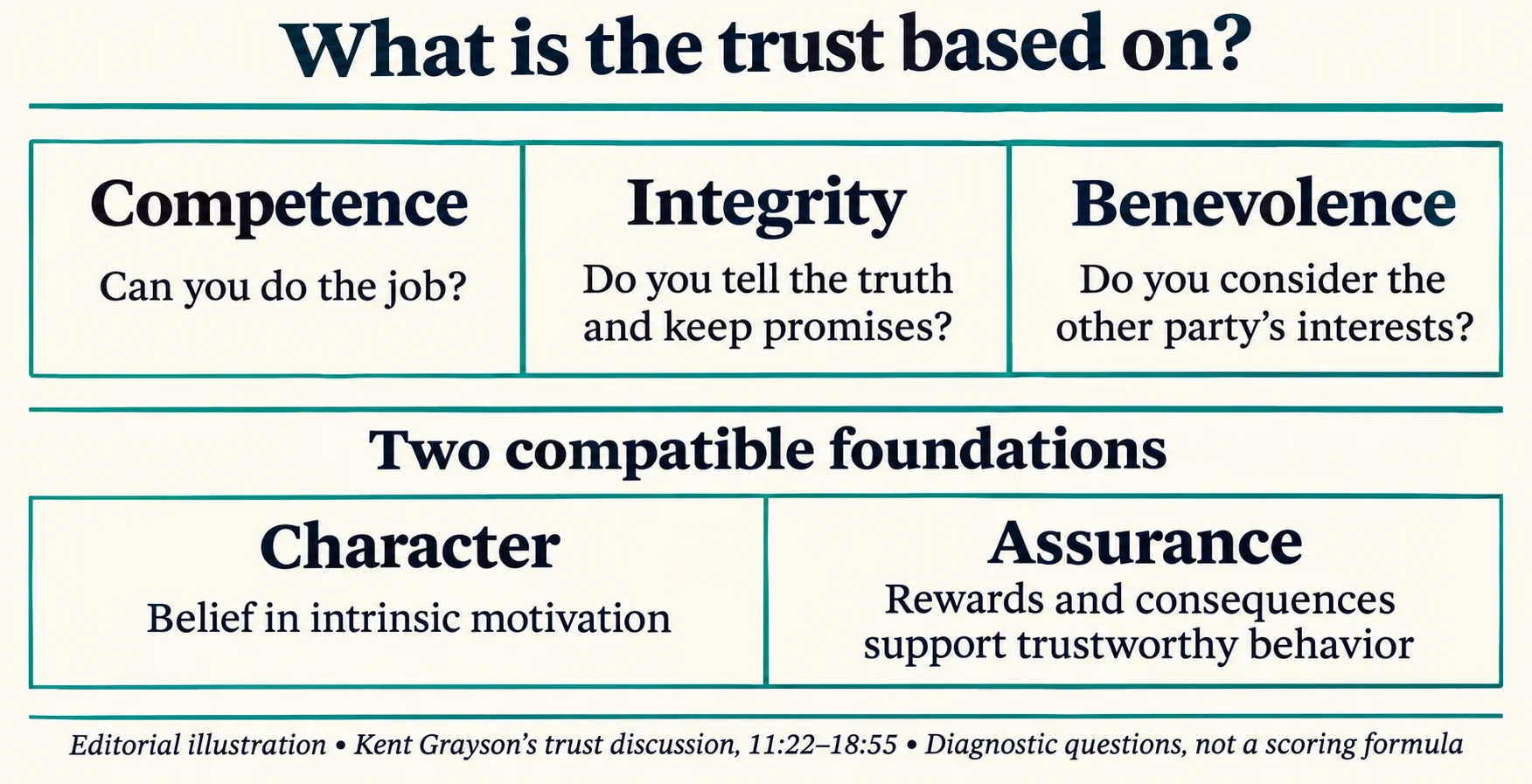
Those questions can produce different answers for the same brand. A customer might believe the product works while doubting the company's promises or whether it cares about the customer's outcome. A single yes-or-no trust label can hide the source of the problem.
Measure more deeply when the diagnosis requires it
Source 14:07Grayson resists adding a separate trust study simply because trust matters. Existing brand research may already show a consistent, positive expectation of a particular offer. His inexpensive instant-coffee example illustrates trust in a defined role, rather than unlimited confidence in everything the company does.
When a company has inconsistent or negative perceptions, a more explicit diagnosis can be useful. Separate questions about competence, integrity and benevolence can reveal what needs repair.
He also allows variation in the framework: an organization may use other names or a different grouping. The requirement is to understand the basis of the relationship well enough to distinguish what is working from what is not. Collecting another undifferentiated score may add little.
Character and assurance are compatible foundations
Source 16:27The next distinction concerns why someone believes a company will behave well. Character-based trust rests on perceived intrinsic motivation: a founder cares about the problem, wants the product to work and feels responsible when it does not.
Assurance-based trust rests on incentives and consequences. A person may believe an organization has reason to behave responsibly because misconduct is punished and trustworthy behavior rewarded, without assuming pure motives.
Grayson says the two are not mutually exclusive. The same relationship can draw on both. A founder story can communicate character, but the story alone does not prove it; credible mechanisms can provide another basis for confidence. The interview's regulatory examples illustrate this distinction rather than verify a particular product's safety or approval.
The channel can lend credibility, but the audience matters
Source 19:35The hosts identify themselves as a television agency and ask whether TV can function as a trust signal. Grayson agrees that a message's source and surroundings can influence its credibility, much as a spokesperson can.
He immediately qualifies the point: different audiences trust different media. Someone who does not watch television may not grant it the same credibility. A placement next to trusted content and one next to untrustworthy content may also affect interpretation differently.
The discussion therefore does not establish that TV is universally the most trusted channel or that buying a placement makes a brand trustworthy. The channel contributes to how an audience reads a message; it does not replace the conduct and evidence behind it.
AI can imitate a signal without creating the underlying character
Source 22:02Grayson uses influencer marketing to describe a cycle of credibility renewal and erosion. Enthusiasts initially offer recommendations grounded in genuine interest. Commercial adoption can make that form more useful, but paid praise without sincere belief teaches audiences to be more skeptical.
He expects synthetic founder stories to create a similar problem. If a fictional founder can convincingly perform the familiar signals of authentic motivation, the format becomes less reliable as evidence. That is an argument about a possible erosion of a signal, not a claim that every founder video is fake or that all audiences respond identically.
He gives earlier involvement of an influencer in product development as one way brands seek more genuine commitment. Even that practice can eventually be imitated. The enduring task is to connect communication to real involvement and value, rather than look for a persuasive format that can never lose credibility.
Trustworthy strategy precedes trustworthy creative
Source 26:25Asked what components he would put in an advertisement, Grayson returns to strategy. A brand that wants trustworthy communication must first be competent, honest and attentive to the other party's interests in the thing it actually offers.
An agency can then find a creative way to communicate those qualities. Without that ground truth, a polished execution risks presenting a character the company does not possess. His examples concern making a real identity legible, not manufacturing trust through a checklist of visual cues.
This keeps the discussion practical without pretending one creative tactic always works. Ads can still miss, but a trustworthy brief begins with something the organization can substantiate outside the ad itself.
Transparent methods let other people judge the claim
Source 28:27Grayson says practitioners sometimes underestimate the detail and independent scrutiny involved in academic publication. Questions about data collection, measurement and causal interpretation can expose weaknesses and prompt another study or a better analysis.
Transparency also serves the reader. His hypothetical engagement measure illustrates why definitions matter: watching for thirty seconds is different from watching for ten seconds or a minute. The same word can conceal a materially different observation.
Peer review is not infallibility, and a lack of published detail does not prove a result is false. It does limit how confidently someone can evaluate it. Before using a broad claim to justify a substantial campaign, a practitioner should be able to ask what was measured, how the conclusion follows and what scrutiny it has received.
Openness to criticism is useful when there is something real to inspect
Source 36:36The closing superhero discussion is playful, but returns to the same principle. Grayson sees willingness to acknowledge weaknesses and face criticism as one way to demonstrate confidence in an argument. His comparison to research is about making the case available for examination.
Being entertainingly transparent about untrustworthy behavior does not automatically make the behavior trustworthy. Nor does choosing a heroic spokesperson transfer every admired quality to a brand. The joke works because the underlying dimensions still have to be considered separately.
The interview's growth argument therefore starts with a relationship the company can support: deliver the promised value, explain it honestly, consider the customer and let evidence withstand questions. The message can help people recognize those things; it cannot do their work for them.