
Continuous consumers change the shape of the marketplace
Source 02:47Alex Atallah describes products through publishing and subscribing to data. In a marketplace, a supplier publishes an offering and a buyer chooses it. Agents and inference-consuming applications can make those choices continuously rather than as occasional human purchases.
He sees OpenRouter as a combination of an API and a marketplace: developers need a callable interface, but also a way to discover and compare model offerings. His recollection of early open models explains why he expected a diverse supply of capabilities rather than one permanent choice.
The interview's early fine-tuning anecdotes are not a complete cost model for creating a production service. The more general thesis is that new model variants create a discovery and distribution problem as well as a training problem.
Community moderation exposed a need for control
Source 10:31Anjney Midha recalls deploying models at Discord, where communities had different norms. A general moderation endpoint and a model interpreting a particular community's rules were not the same application.
In his account, early post-training restrictions sometimes prevented the intended moderation task. That made more control over the model and deployment important to him. Atallah adds another example of users wanting an alternative when a model could not complete a creative task.
These are historical accounts of specific deployments, not evidence that a provider's current service behaves the same way. They explain demand for choice and control without proving that unrestricted model access removes every moderation or safety responsibility.
Model diversity was the premise, not an incidental feature
Source 16:52The guests recount an early objection: if one model company captured almost all value, a marketplace would have little left to do. They instead expected different teams, capabilities and deployment choices to persist.
Their argument combines research diversity with practical differences in what applications need. Speed, price, customization and acceptable behavior can matter differently across tasks. A developer can have a reason to choose something other than the model that leads one broad benchmark.
That is a thesis about the ecosystem, not a guarantee about its eventual market structure. The interview does not establish that no provider can gain substantial power or that every application needs to use several models.
A finished checkpoint is not a finished developer product
Source 19:47Midha describes a recurring gap between research teams producing a checkpoint and developers being able to use it. Keys, provisioning, endpoints, version management, distribution and feedback all require work after training.
Atallah adds a discovery problem: models are difficult to describe as a simple feature list. People need examples and ways to understand which capability fits their application. He presents the marketplace as a neutral layer that can help reveal those differences.
Neutrality is the company's stated positioning, not an independent finding that all incentives or comparisons are unbiased. The concrete observation is that a proxy forwarding one request leaves much of the developer experience unexplained.
Community work can reveal the missing experience
Source 29:50The guests connect marketplace building with earlier community experience. They describe finding a technical gap people actually cared about, building for it and learning from many users in one place rather than only from isolated interviews.
One recalled Discord integration met the technical requirements while bouncing the user to another site. Atallah argued for keeping the interaction embedded. Midha uses it as an example of asking whether a working integration is also the best user experience.
The story is a recollection, not a controlled product experiment. Its role in the interview is to show why the boundary between two companies or systems should not automatically determine the boundary the user experiences.
Window AI helped identify the limits of a browser form factor
Source 35:37Atallah describes an early browser extension that let users choose the model a page would call. The experiment also connected him with a future co-founder through open-source contributions.
He concluded that the product needed an API and more room for discovery: examples, graphs and exploration that a small extension did not provide. A useful prototype could therefore lead away from its original interface rather than become the final product.
The comparison with Midjourney makes the distinction clearer. Watching other people make images could be part of the end-user experience. Building an application on language models additionally required code integration, access governance and data policies. A shared chat community was not sufficient for that job.
Faster can feel smarter without proving greater accuracy
Source 45:33The Mixtral discussion links model demand with competition among inference providers. The guests recall developers wanting to try an open model and providers competing to offer attractive performance and prices.
They also question whether speed influenced perceived intelligence. Midha explicitly says the accuracy comparison would need to be checked against data. The article therefore does not convert that speculation into a benchmark result.
The practical distinction is between latency, task quality and human preference. A fast answer may be useful, while a harder task may justify a different model. The conversation presents manual model switching as one precursor to automated routing.
An evaluation researcher and an application developer are different customers
Source 49:08Asked why OpenRouter did not become Arena, the guests distinguish the intended customer. An evaluation service addresses researchers measuring models; a deployment marketplace serves developers building applications from those models.
Atallah also describes conservative prompt and completion handling, subject to provider policies and opt-in settings. Those are his statements in the interview, not a current privacy contract verified here. An application still needs to examine the policies that apply to its actual route and configuration.
The product lesson is focus. Adjacent tools may look similar from a distance while serving different expectations, data relationships and business models. Trying to own every nearby workflow can weaken the one a company set out to serve.
Abandoned prototypes show the cost of an adjacent idea
Source 57:09Atallah recalls a video-based fine-tuning prototype that did not become the main product. The team also tried combining several model responses with a stronger model synthesizing them.
In the earlier fusion experiment, the combined output could be no better, or worse, than simply using the strongest model. More models were not automatically more useful. The team removed the prototype rather than continue splitting focus indefinitely.
He later revisited fusion as models became more comparable. Personal spot checks and the models' favorable judgments encouraged further evaluation, but they are not independent proof of superiority. The interview leaves model quality, form factor and careful benchmarking as conditions that can change whether the idea works.
Capability, usage and cost pressure can reinforce one another
Source 64:41The guests describe a recurring pattern: a model capability enables new applications, usage rises, bills become noticeable, and developers look for more efficient alternatives. A marketplace can be useful at both the discovery and cost-management stages.
New agent patterns also create different kinds of calls. A lightweight heartbeat need not have the same cost or capability requirements as difficult coding work. That makes routing a question about the task, not just allegiance to one model.
Token counts, account counts and dollar activity are separate measures. The interview contains large reported usage figures, but they should not be read as unique active customers, audited revenue or the economic value created by every call.
Runaway usage is not the same as an attack
Source 71:01Atallah's abuse examples include stolen payment methods, compromised accounts and unauthorized resale. He separately describes an agent accidentally running up usage while its operator does not realize what is happening.
Those cases call for different responses. Detecting malicious access and helping a legitimate customer regain control are related to trust, but not identical to diagnosing a runaway workflow. He describes operational work by the trust-and-safety team rather than only a model-level refusal policy.
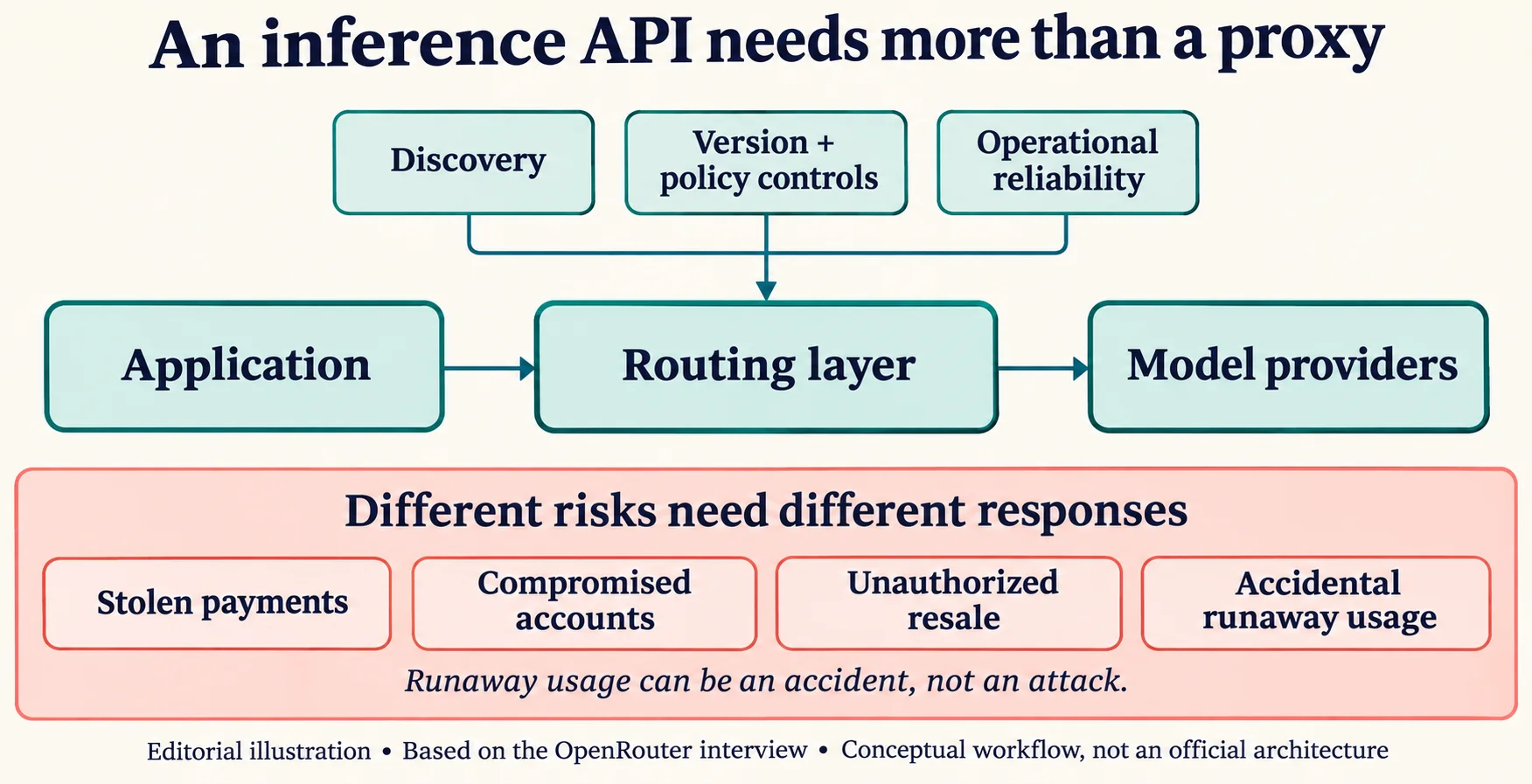
He also speculates about businesses charging for tasks or events while users bring inference separately. That is a possible pricing direction, not proof that task-based products are immune to fraud or that reselling inference cannot be viable.
The trillion-dollar economy is an argument about future infrastructure
Source 74:42Midha compares token flow with the growth of online payments and recounts abuse around early image-generation trials. The analogy is that a valuable service at scale attracts attempts to obtain it illegitimately, creating demand for new protection.
His five- and ten-trillion-dollar figures are forecasts over future years. They are not measured present market size, a token-count conversion or a validated estimate of GDP growth. His concern about agent-driven attacks likewise describes a prospective risk, not an observed total of future losses.
The useful design question survives without accepting the forecast: as applications expose economically valuable inference, how will they detect abuse, contain mistakes and preserve a usable experience for legitimate customers?
Partnership plans do not replace an operating guarantee
Source 80:56The interview closes with the guests framing the Stripe relationship around distribution and trust-and-safety capabilities. Atallah says the OpenRouter brand and product direction will continue, with near-term work intended to move faster.
These are statements and plans from the recorded conversation, not fresh reporting that independently confirms a transaction or guarantees today's roadmap. The article does not turn them into a service-level or privacy promise.
Across the history, the same theme recurs: useful access to intelligence includes the work surrounding the call. Discovery, clear customer focus, governance, cost choices and operational trust are part of the product, and each needs evidence beyond a large token total.