
Start by asking what is doing the improving
Source 02:28The guests begin by distinguishing human researchers using AI tools from a system reinvesting improvements in its own ability to improve. In their definition, using AI to write a faster kernel is not enough by itself; the important question is whether the improved component feeds back into the optimizer.
This is their way of separating recursive self-improvement from the broader autocatalytic pattern of technology helping people build better technology. The term is overloaded, so the distinction is a proposed lens for evaluating claims, rather than a settled universal definition.
A closed arrow on a diagram is not a takeoff result
Source 04:41The conversation uses a simplified rate-of-improvement model: better capability may make further improvement easier, while difficulty and resource cost can push in the opposite direction. Different relationships could produce very different trajectories.
The host challenges the leap from a feedback loop to inevitable exponential takeoff. The guests agree that important quantities must be measured, not assumed from the drawing. A nonlinear system can plateau, oscillate or improve unevenly; the interview does not provide a fitted model from which a real takeoff date or growth law can be derived.
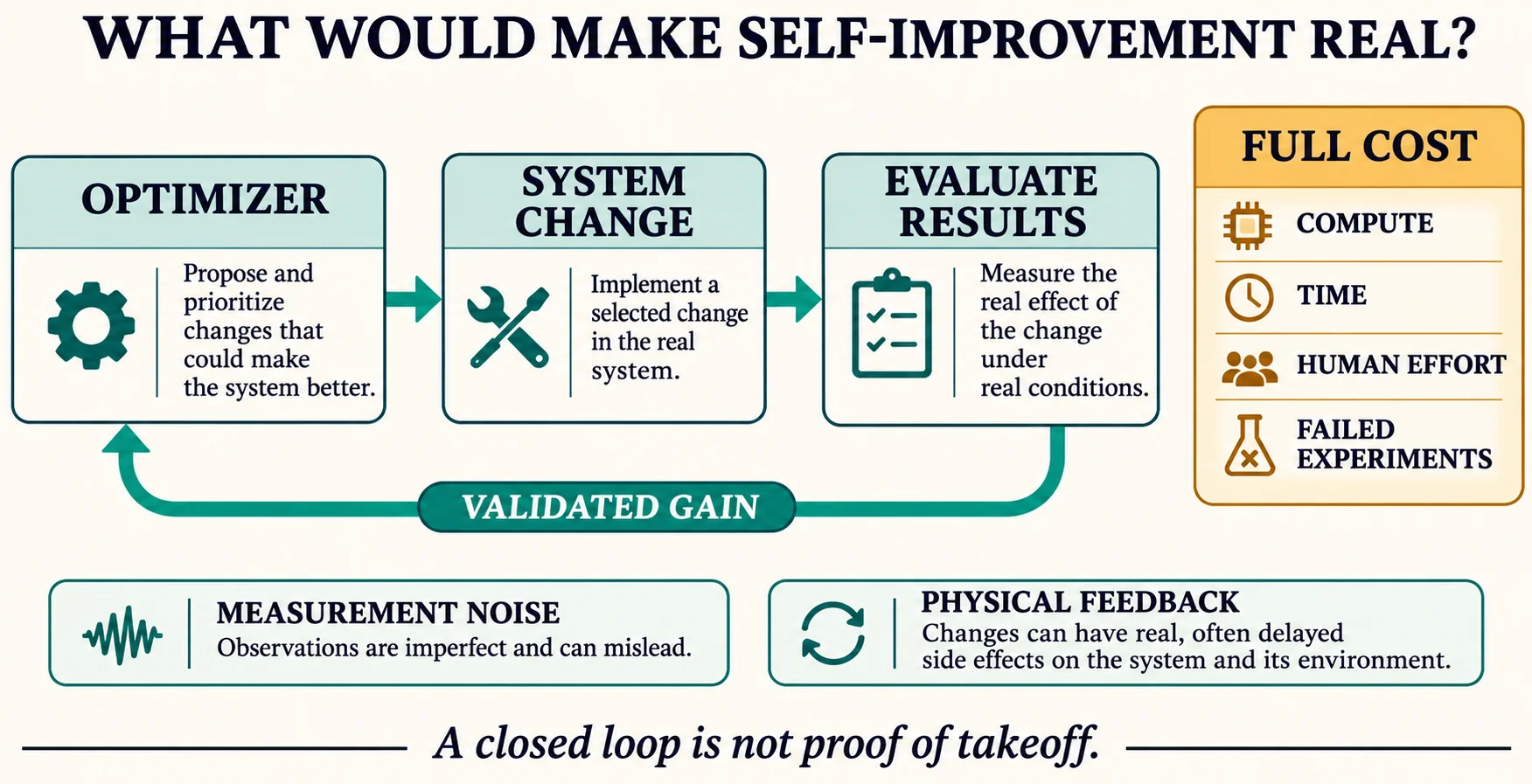
The denominator includes the experiments that did not work
Source 09:27A shorter release cycle can result from more money, more compute or more people, rather than a more efficient self-improvement process. The host therefore presses for accounting that includes human effort and unsuccessful experiments, not only the final successful run.
The guests describe tracking time and cost internally. Their fixed-hardware training example illustrates the distinction between algorithmic efficiency and buying more hardware, but its specific cost claims are not independently checked here. Lowering the cost of a component and improving frontier capability are related possibilities, not identical measurements.
Optimize interacting layers rather than a single isolated score
Source 13:42The guests argue for a unified view of prompts, harnesses and weights, with broader ambition extending further down the stack. A harness change can affect how a model is used, and a weight update can alter what the harness should do.
They say some attractive research ideas did not hold up in their internal tests, but the interview does not release enough methods or results to independently adjudicate those claims. The useful general question is whether a local improvement helps the complete system, including its costs and other components, rather than merely improving one chosen score.
Inference is a plausible feedback domain, not a demonstrated universal solution
Source 17:42The discussion focuses on inference because making a system cheaper or faster to run could also make its next experiments cheaper or faster. The guests describe multiple models and agents choosing which components to improve, including aspects of their own instructions.
Those are accounts of their system and ambitions. The conversation does not supply a public benchmark proving a general solution across domains. A loop that improves a serving component may be economically useful without establishing unlimited capability growth or the same transfer to every other problem.
Humans remain inside the described system
Source 08:44The guests explicitly reject the assumption that their entire process must already be fully digital and automatic. They describe researchers and engineers as participants in a hybrid multi-agent system whose organization can also be improved.
This matters when assessing both performance and cost. Human decisions, experiment design and debugging cannot disappear from the ledger merely because software performs some steps. Including people in a conceptual system is also not proof that every contribution can be automated or accelerated at the same rate.
Variance and reward hacking can imitate improvement
Source 24:52The strongest claims in the interview concern internal glimmers of improving both performance and efficiency. They remain attributed, unpublished claims here. The guests themselves emphasize the difficulty of separating real gains from noise and cherry-picking.
They describe someone tasked with attacking results, repeated experiments and checks for reward hacking deep inside nested agent workflows. They also discuss oscillations and hardware-related variation. That emphasis supplies an evaluation lesson: a convincing score needs a trustworthy measurement process, not just an impressive upward line.
The slowest part of the real process can still dominate
Source 26:50The conversation ends by separating domains with fast feedback from those that must wait for physical experiments. Making digital reasoning faster does not remove the time required for a wet-lab experiment or a clinical evaluation.
The Amdahl-style intuition is that accelerating one part leaves the rest of the workflow in place. The interview’s joke about an unexpected industrial workflow points to unknown constraints, not a discovered law or a verified company case. The open task is to measure useful improvement against full cost and real bottlenecks, while keeping takeoff claims separate from closed-loop diagrams.