
The original niche did not support the software he had built
Source 00:43Nevo David says the product began as Git Room, a tool connected to his consulting work helping open-source companies with marketing. A narrow specialty could support high-priced advice but proved difficult to sell as a software business.
He saw that much of the product could become a general social-media scheduler and changed the positioning to Postiz. This was a reuse of existing work, rather than starting a wholly unrelated product. He also recounts an earlier outreach business where lifetime deals contributed to cash-flow problems and debt.
The interview's revenue figures describe his reported journey at the time. Its title and spoken milestones differ, and the conversation is not an independent financial audit. The more useful thread is how the same core product found different reasons for people to encounter and use it.
Development and distribution were planned together
Source 05:12David describes organizing early development around releases he could explain publicly. A month of building would produce a package of changes that made a useful launch story, with Reddit as the main initial destination.
He did not treat marketing as a task to begin after an unlimited period of coding. The intended audience and launch format influenced what he planned to build and how he would describe it.
That is his operating history, not a universal argument for prioritizing broad feature lists or sacrificing quality to create announcements. A feature's usefulness and the way to communicate it are related questions; an announcement alone does not establish customer value.
Open source supplied a reason for the community to care
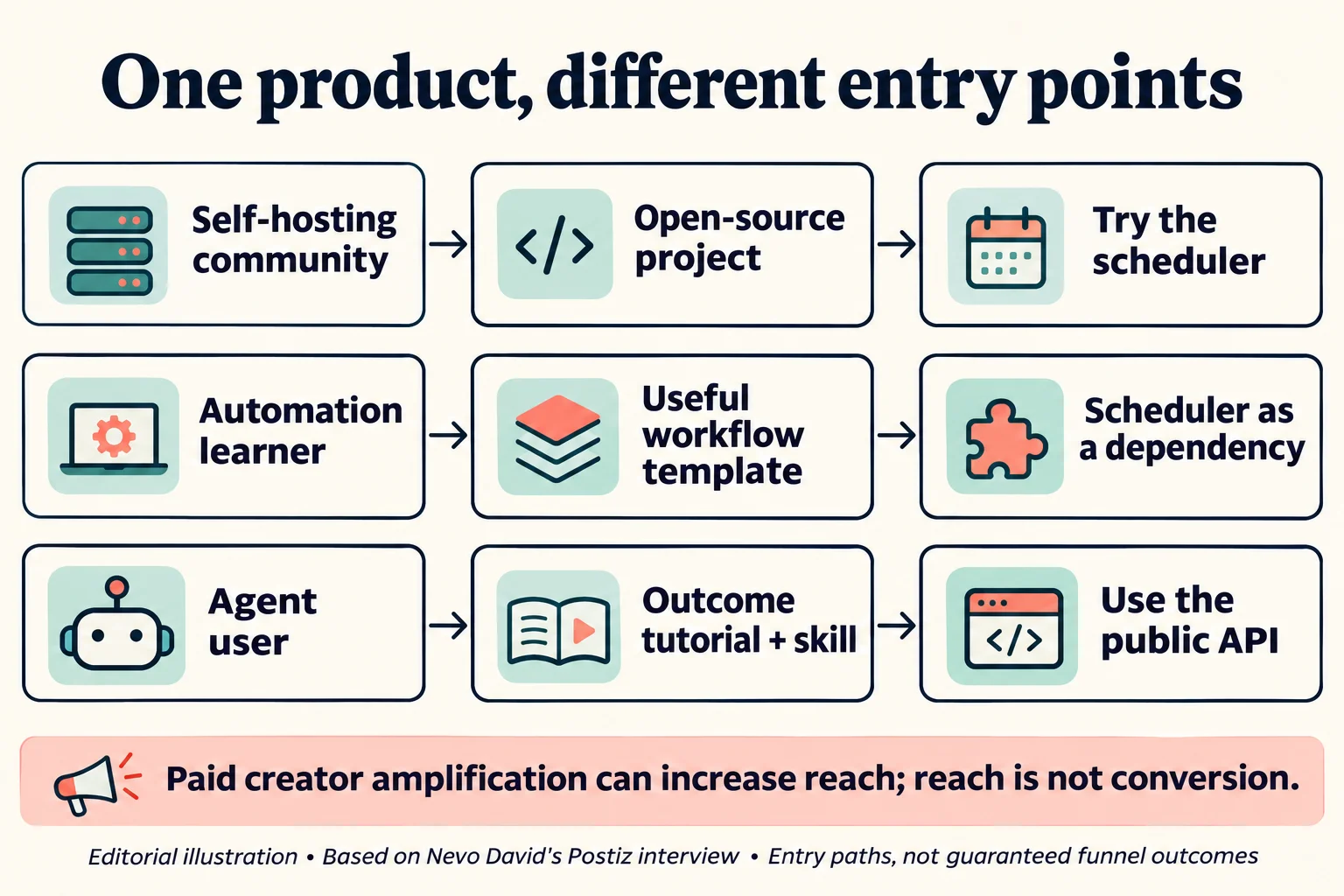
Source 07:59Postiz's open-source version fit self-hosting communities because members could actually use what was being shared. David contrasts that with a generic promotional post offering little to the reader.
In other communities, he emphasizes useful explanations and a recognizable association with the project, rather than repeatedly presenting a product pitch. Consistent participation mattered in his account. His reported post views are examples from that period, not a promise that the same format will receive similar reach now.
The immediate destination was often the repository, where attention could lead to trials, stars or further discovery. Those are different outcomes from paid subscriptions. He also mentions Lemmy, while acknowledging he did not have the same view-count information there.
User-made automation content revealed another entry point
Source 13:04After repeated launches, David noticed people making videos about the self-hosted product. Some used it in n8n workflows rather than as a scheduler operated manually by an individual creator.
He responded by approaching automation communities and their owners. His offer could include access to the product or distribution through his newsletter; he wanted Postiz included in useful templates, not necessarily to sell a subscription to the community owner.
This changes the buyer's context. Someone seeking an automated content workflow may discover that a scheduler is a required component, rather than begin by comparing scheduling tools. The workflow supplies a reason for the tool to matter at that moment.
An existing API made agent integrations easier to package
Source 20:10David describes experimenting with MCP and then agent skills as attention shifted toward agents. Because a public API already existed, instructions for using it could connect the product to another workflow without rebuilding the scheduler.
He credits Oliver Henry for an early example of using Postiz with an agent to promote an application. Later content adapted similar outcomes to other agent tools. The recurring value was the workflow; a new integration or tutorial supplied another discovery route.
His explanation of interest-based social feeds is his interpretation of distribution, not a verified account of a platform's current algorithm. Moving quickly around a trend worked in his story, but does not establish that mentioning a newly released agent will create demand.
Use the evidence of the person who actually did the work
Source 26:15David says he often presents other people's workflows because he has not personally performed every use case. He wants concrete examples from people who achieved an outcome, rather than claim their results as his own.
That includes an important distinction in the interview: the host's successful consumer-app slideshow is not evidence of the same conversion pattern for Postiz's business audience. David says he focuses more on X and does relatively little direct TikTok work himself.
A useful case needs the operational detail that explains what was tried and what happened. Specificity can make an account more informative, but does not by itself prove a revenue claim or make a reported success reproducible for every reader.
Scaling the content operation required money and collaborators
Source 29:27As the business grew, David describes paying creators, collaborating with complementary tools and offering distribution in exchange for a useful case. Some contributors were already users; others needed to install and learn the product before writing about it.
That let him publish more than he could write alone. It also means the later system is not simply a free organic-marketing trick. Product access, creator fees and amplification are inputs whose cost belongs in the account of the result.
The host says this interview itself was unpaid. David separately says paid reposting partners use promotion labels. Those are their disclosures, not an independent check of every campaign or a guarantee of compliance with every platform rule.
Paid amplification is a separate mechanism from the article
Source 34:00David describes observing paid quote-posting campaigns elsewhere, then building a system to coordinate creators around an article. A campaign could notify participants and schedule a window for reposting.
He gives a historical price range of roughly $80 to $350 for a creator's quote-post, while emphasizing that campaigns cost substantial money. The figure is his quote at the time, not a current market price. His account also includes changing results from meme-based reposts and uncertainty about platform changes.
A strong article and an amplification budget therefore need to be distinguished. Reach attributed to a content format may partly reflect purchased distribution. Neither a large view count nor synchronized reposting establishes how many people became customers or whether acquisition was profitable.
Broad attention and useful conversion are different tests
Source 37:50For his own educational material, David also describes reusing a main piece with additional context in later posts. He treats this as a different use of an established audience from a paid product campaign.
He says posts about his recurring revenue can draw broad attention without converting as well as detailed workflow content. The technical account reaches someone who can recognize a relevant job, while a business milestone can attract people with no intention of using the product.
That distinction is more durable than a particular posting trick. It asks whether the audience is learning something that helps them act, and whether the observed response moves beyond exposure. Generic enthusiasm is not the same evidence as someone choosing and successfully using the service.
AI-search visibility was not his main measurement system
Source 42:04Asked about language models mentioning Postiz, David describes submitting the product and its skill to directories and marketplaces. He sees those as potential discovery sources, while admitting his effort on AI SEO is limited compared with social distribution.
He also offers possible explanations for a large skill-download count, including self-hosted use and repeated downloads. That is a reminder not to equate downloads with unique active people or paid customers.
The conversation does not isolate a causal effect on AI recommendations or guarantee citation. His next channel experiments, including creator videos elsewhere, remain directions he is trying, not proof that one platform universally fits business customers and another only fits consumers.
Bootstrapped did not mean working entirely alone
Source 47:10David distinguishes avoiding external funding from being permanently a one-person operation. He says he used freelancers before hiring and later added support, development and marketing help.
The team works mainly through text in Discord, with meetings when needed. His own preference is to preserve time for marketing and use automation where possible. His views about how many developers to hire or which entrepreneurial personalities to recruit are preferences in this company, not general laws about motivation or productivity.
That staffing account matters when interpreting the headline story. A founder may remain the public face while other people and paid services carry part of the work.
A lower technical barrier makes distribution more important
Source 51:24David rejects a blanket statement that SaaS is dead. He distinguishes products with a relatively low technical entry barrier from businesses protected by harder technology or by a marketplace whose participants are difficult to move.
His argument is that building a similar interface is different from acquiring and retaining an audience. He sees temporary openings in consumer-app distribution too, but does not present them as guaranteed opportunities he would personally pursue.
These are his competitive judgments. They do not demonstrate that a particular industry is safe, that marketing alone creates a defensible business or that a popular product can ignore the reliability of what it delivers.
Persistence meant changing the route, not freezing the plan
Source 57:14David recounts a period around $3,000 in monthly recurring revenue when growth stalled. He continued consulting until the product could support more of his income, rather than make the entire journey an all-or-nothing bet.
He also tried other ideas and returned to Postiz. Accumulated recognition, existing users and distribution made another improvement to the established product different from launching a new domain from zero. He says he would now prefer one related project to live inside Postiz rather than as a separate company.
The final distinction is between commitment and rigidity. He stayed with the product while adapting from community launches to automation and agent workflows. The interview offers a record of those experiments and their costs, not a magic launch formula or a promise that attention will turn into revenue on schedule.