
AI helped her think through a career decision
Source 02:09In this AI & I conversation, Every staff writer Katie Parrott talks with Natalia Quintero about writing with AI and building Compound Writing. Their discussion follows the work that surrounds a finished article: gathering context, deciding what matters, editing and retaining feedback for next time.
Parrott first used ChatGPT as a career coach after losing an editing and ghostwriting role. She wanted an outside perspective but did not have the budget for a human coach while facing an uncertain period without work. She already had some experience using the model for repetitive content tasks.
What she valued was externalizing her thinking and being challenged when she imagined the worst. The clarity still required her participation. In the earlier essay quoted during the interview, she says the answers came through engaging with questions and prompts, rather than arriving ready-made from an assistant. That experience helped her consider a freelance column at Every while continuing to think about full-time work.
More output depended on preparation and repurposing
Source 08:26Quintero recalls a two-week freelance commitment in early 2025: eight blog posts, three ebooks, 24 LinkedIn posts, 24 X posts and 16 Instagram posts. Parrott says she was discovering what she would later call context engineering.
She supplied the model with brand messaging, product information and audience specifics. That foundation made it easier to steer outputs in the intended direction. Much of the work also involved repurposing: adapting an existing piece for another channel, rather than inventing every asset independently.
The effort was concentrated at the beginning. Documents, tools and context took time to arrange, but once that environment existed she could iterate more quickly. She presents the larger output as a result of that preparation, not as evidence that a bare request to generate content produces equivalent work.
Audience and differentiation come before tone
Source 11:45Her early context files lived in Google Docs and had to be copied into conversations. Later, projects and custom instructions reduced that repetition. She created a project for each freelance client and for each column.
The contents came from familiar content-management work: who the audience is, its problems, how a product addresses those problems, competing offerings and the company's differences. These questions came before preferences about vocabulary, reading difficulty or tone.
A model needs those foundational constraints to work in a useful direction. A style guide can help with expression, but it does not supply the reason an audience should care about the piece or the particular thing the writer has to say.
The writer supplies the fresh ingredients
Source 15:49When Parrott talks about research, she means the material specific to a piece: a company's study, third-party research, personal experience or a distinctive insight. Asking for a post based only on what the model already knows tends to draw on information available to everyone else as well.
Quintero compares the process to bringing fresh ingredients to a recipe. Parrott extends the analogy: the model is the kitchen, outlining is like chopping, and composition is like boiling. The ingredients still have to be good.
She says working with AI restored some enjoyment in writing. When sentence assembly consumed less of her energy, she had more left for the harder questions about what the sentences collectively said. The goal was room for exploration and argument, rather than simply getting a passable draft off her desk.
Support around the work preserves capacity
Source 27:12Parrott also describes AI as supportive technology. She gives personal examples of reducing inbox friction and researching an overdue appointment. In the appointment example, the agent found possible physicians and she made the booking. These are accounts of practical support in her own life, not claims about treatment.
Her career coach has since become a project in Codex. It contains information about her role, Every's positioning, performance evidence from the content system, reader feedback and quarterly objectives. She uses it to connect her work with the organization's priorities.
Voice conversations help her sort competing tasks, and the system maintains a Kanban board with deliverables and dates. To create the context, she often asks AI to interview her. Questions draw out what she thinks before those answers become documentation. The surrounding system, like the article itself, depends on information she supplies.
Compound Writing retains feedback for the next piece
Source 32:38Parrott defines compounding as feeding each piece of feedback back into the system so the next output improves. Inspired by Compound Engineering, she adapted an existing workflow to writing through conversations with Claude.
There are similarities: brainstorming, planning or outlining, doing the work and reviewing it. The criteria differ. Writing review concerns structure, voice and evidence, rather than programming conventions.
She separates substantive editing, which examines the argument and large-scale structure, from line editing, which examines individual writing, and a final pass for publication details. Style guides and example pieces remain part of the context. The writer then brings new material into that established process.
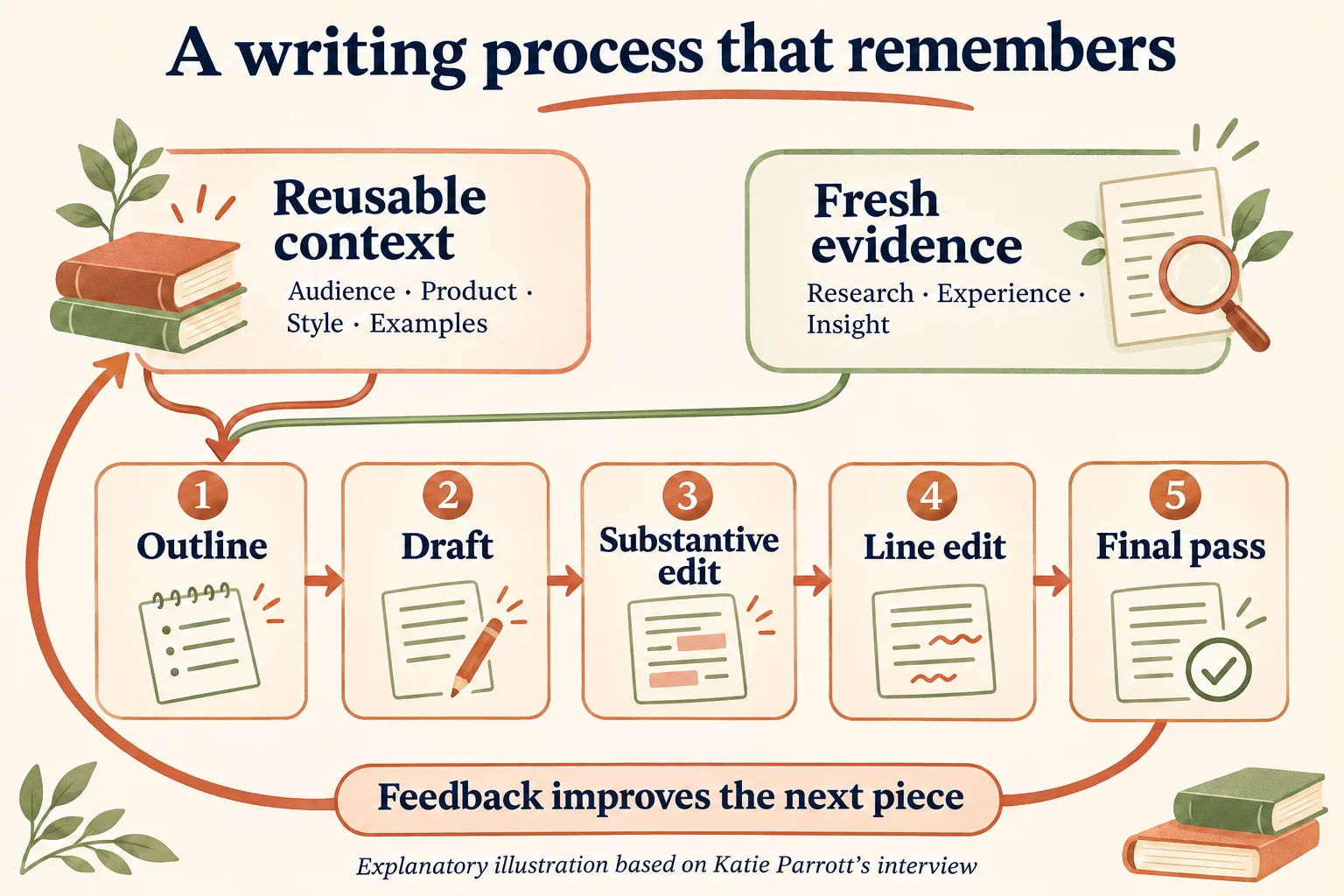
Explanatory illustration based on the interview: reusable context and new evidence enter the writing process together. It is not the original plugin interface.
Review lenses can help a writer develop taste
Source 38:45Parrott calls the plugin a gym for writing. One review lens draws on Kurt Vonnegut's story principles, such as making sentences earn their place and giving readers a character to care about. Another uses Hitchcock's distinction between surprise and suspense: revealing the danger can make readers anticipate what happens next.
She is explicit that this is borrowing a framework, not having the author's spirit review the work. Different lenses ask different questions of the same draft. An experienced writer may benefit because it is hard to keep every perspective in mind at once.
Quintero adds that a user can disagree with a lens and discover a preference of their own. A useful process supplies something concrete to react to. It does not remove the effort involved in making high-quality work.
Building a tool still requires checking what it does
Source 42:59The conversation includes a software example that limits the promise of easy creation. Parrott built an MCP connection for Tastemaker, an app that collects admired writing and distills it into a style guide. She wanted to add clips and retrieve the guide directly from her working environment.
Claude helped build it, but a subsequent Codex review identified five security vulnerabilities, she says. The example is part of her account of being able to build things she previously could not, alongside the possibility of introducing problems she did not initially recognize.
Her story therefore includes both assistance and checking. Generating the connection was not sufficient evidence that it was ready or secure.
Compounding depends on who can access the conditions
Source 45:04Asked for her broader thesis, Parrott emphasizes education and access. She points to the conditions that helped her learn: professional connections, enough financial comfort, time to experiment and a budget for tools.
Those conditions are not equally available. Her concern is that the compounding benefits could accumulate among a small early group. She wants more people, in more places and circumstances, to have the opportunity to participate.
That concern sits alongside the practical writing method. Documenting expertise can make it easier for someone else to start, but access to the process, the tools and the time to learn still matters.
Adapted from Every's AI & I episode “How a Professional Writer Writes With AI,” with Katie Parrott and Natalia Quintero. Sponsor material and the promotional closing are omitted.