
A vendor’s thesis about the next security cycle
Source 03:09The a16z conversation presents Armadin’s thesis that AI-assisted offensive testing and defensive response must evolve together. The guest describes starting with finding exploitable risk, then using that evidence to help defensive systems act more quickly.
The setting is a company interview with an investor partner, not an independent security benchmark. Product claims, customer observations and forecasts should be read with that commercial context. The article explains the proposed workflow without treating a force-field metaphor as a protection guarantee.
Scale changes the problem, but coordination still matters
Source 04:27The guest argues that models can explore and repeat work at a scale a human team cannot match in the same way. He also describes current agents revisiting already explored paths or behaving inefficiently, so more activity is not automatically better reasoning.
His projections about attacker capability and attribution are expectations about a changing threat environment. The interview does not establish exact universal speed ratios or demonstrate that every AI-driven intrusion is more effective. The useful distinction is between increased capacity to attempt work and verified success at a well-defined objective.
Continuous assessment can be driven by meaningful changes
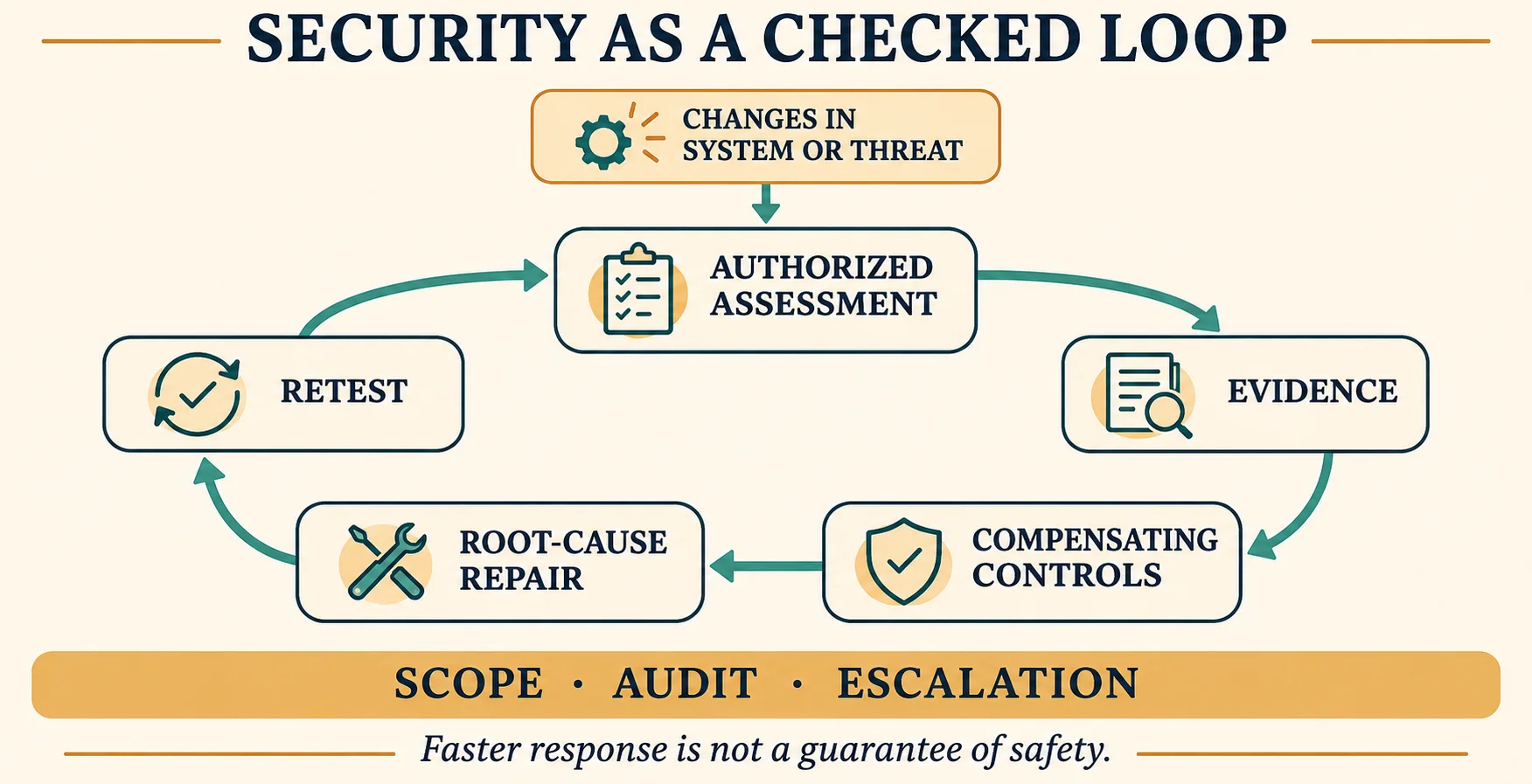
Source 10:24The described approach first builds a view of a customer’s environment, then watches for relevant changes. A new route, application update, system change or change in threat knowledge can trigger another assessment. A separate audit request can also be a reason to test.
That is more specific than attacking everything every second. It aims to focus effort where the prior assessment may have become stale. In a customer testing context, scope and authorization remain prerequisites; the interview is not an instruction to test arbitrary networks or an implementation recipe for exploitation.
A finding, an exploitable path and business impact are different claims
Source 14:43The guest wants evidence that a reported weakness can matter in the actual environment, rather than a long undifferentiated list of possible issues. That distinction can help prioritize work, but his broad characterization of traditional penetration testing is a vendor comparison, not a definition of the entire profession.
Claims of no false positives or exhaustive coverage are not established by the interview. Even a demonstrated technical effect needs context about scope and consequence. The reported count of more than 90 zero-days is also a company claim, without a public case set here that would let readers independently verify each finding.
Compensating controls buy time; they are not the final repair
Source 18:37The proposed defensive phase takes evidence of exploitable risk and informs endpoint or network controls. The guest uses a field-dressing metaphor: reduce immediate exposure, then allow more time for a fuller repair.
The distinction matters because blocking a route is not necessarily removing the underlying defect. The conversation describes an intended development path and integration work, not proof that a complete autonomous defense layer is already operating everywhere. Any control also has to be judged in its operational context, rather than assuming every fast action is automatically the right one.
Fast response still needs layers and escalation
Source 20:57The guest argues that some tactical response windows are too short for a human to approve each step. Yet he also says every defensive layer should be assumed capable of failing, with other layers behind it.
Later, he explicitly describes pausing, escalating and having a person decide when the system encounters something it cannot classify. Those statements should stay together. The thesis is not that humans or accountability disappear, but that a system must distinguish actions it can handle within established bounds from uncertainty that requires judgment.
Domain experts make evaluations meaningful
Source 27:04The security architecture discussion includes isolation, proxies, deterministic rules, model-based classification and detailed logs. The guest links useful evaluation to experienced security operators working with AI specialists, because a generic score may miss domain-specific failure modes.
He describes an internal set of attack-chain evaluations and differing time and cost profiles across models. Without the full suite, harness and budgets, those results do not prove general equivalence between all open and closed models. They illustrate why evaluation conditions, not model branding alone, determine what a result means.
The discovery account still includes substantial human work
Source 34:44A qualification near the middle of the interview is easy to lose in the headline: the guest says humans found most of the reported zero-days while using AI to remove much of the repetitive work. He separately claims that recent examples were found by the technology itself.
Both remain his account, but the distinction prevents a misleading summary that all findings were autonomous AI discoveries. Automation can free experts to concentrate on difficult reasoning without making their contribution vanish. The earlier emphasis on audit trails also remains relevant when reconstructing what actually happened.
Security learning should not depend only on the next victim
Source 35:45The guest contrasts learning from incidents with proactively finding problems in a customer environment. He does not say incident response becomes unnecessary: unknown attacks can still get through and supply information defenders did not yet possess.
The proposed loop is assessment, evidence, containment where appropriate, deeper repair and another check. Its value depends on the quality of each step and the boundaries around it. The interview does not justify an absolute prediction that every organization’s security stack will be replaced on a fixed schedule.
A faster product still needs a functioning company around it
Source 40:07The final section moves from security technology to company building. The guest emphasizes funding, experienced leaders, sales enablement, brand and recurring customer feedback. If the product changes rapidly, a sales team cannot rely on one annual training session.
These are the founder’s operating beliefs, not verified revenue projections or a universal mandate for one working style. His repeated theme is to win customers, make them happy and learn from them. That closes the loop between technical capability and a business able to explain, deliver and support it.