
A skill lost through a cycle of bad experiences
Source 00:43Bo Seo describes two connected failures in public disagreement. Loud, painful exchanges are visible; the people who withdraw because they expect nothing useful are less visible. Each bad encounter makes the next conversation more defensive, which produces another bad encounter.
His answer is to treat disagreement as a skill that needs instruction and practice. He points to the importance of formats that give people enough time to speak and a dependable chance to respond. A relationship larger than the current dispute can also make candor less threatening.
This is an argument about conditions for better conversation, not a promise that debate resolves every political conflict. The interview’s historical examples illustrate Seo’s interpretation of that possibility.
Listening means reconstructing a position the other person recognizes
Source 07:28Seo recalls moving from South Korea to Australia without strong English. Ordinary conversation was difficult to follow, especially when people interrupted or changed direction. The debate team’s rule that one person speaks at a time made participation possible.
The useful lesson is not simply to stay silent. A debater records what was actually said, reconstructs the simplest coherent argument and checks whether the other side would accept that reconstruction. They may then strengthen the argument before answering it.
Responding to a weak caricature misses the point of contact. A stronger version may emerge later anyway. Diverse sources of information help this work, while watching preferred media personalities argue cannot substitute for thinking and speaking for oneself.
Choose one real disagreement before entering it
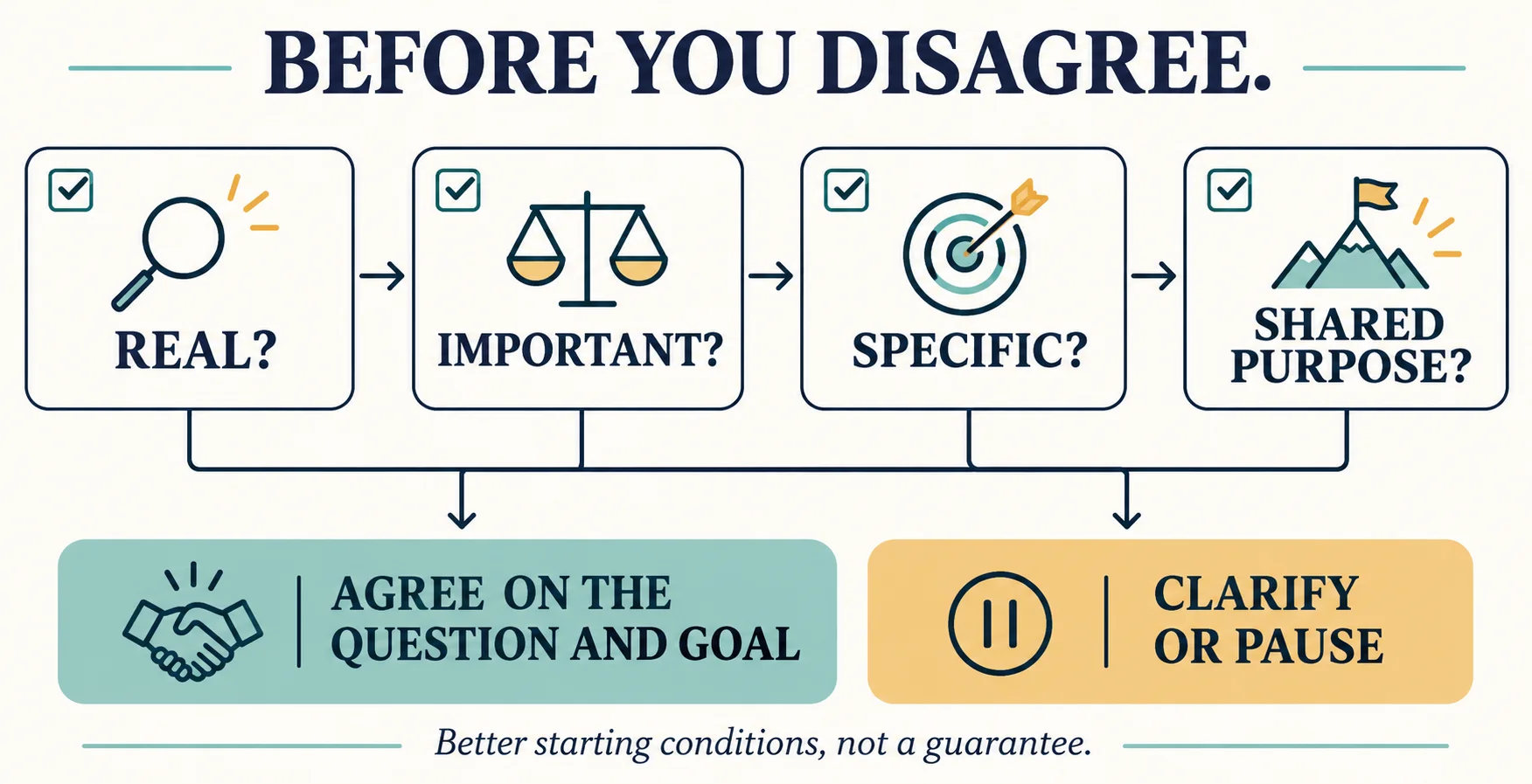
Source 17:00Disagreements multiply easily. One specific complaint can become an argument about every difference between two people. Seo proposes four checks: is the disagreement real, is it important, is it specific enough to make progress, and are the participants aligned about why they are having the conversation?
The first agreement can therefore be modest: name the proposition at issue and the purpose of discussing it. At a family gathering, that might mean asking whether the other person wants to persuade, understand or merely provoke, before launching into the substantive dispute.
These checks improve the starting conditions; they do not guarantee success. If someone expands the topic or changes the goal, the initial agreement provides a way to bring the conversation back. If no constructive purpose is shared, further argument may be the wrong next move.
Switch sides as an action, not a claim to know another mind
Source 23:40Before taking the stage, Seo describes writing the other side’s four best arguments. He also examines his own case through a hostile reader’s eyes and imagines having lost, then asks what could explain that loss.
These exercises interrupt the feeling that one’s own view is obviously complete. They need not produce immediate agreement, humility or empathy, but they create room for those responses by making an alternative position more intelligible.
The exercise works better when a person is seen as more than a party affiliation or ideological category. Its purpose is to discover a possible omission in one’s thinking, not to pretend differences have disappeared.
Connection, boundaries and the special difficulty of loved ones
Source 28:30Seo draws a boundary around debate itself: participants’ equal moral standing is a premise, rather than something to put on trial. Respecting that premise is compatible with strong disagreement on difficult subjects.
He also distinguishes wanting to be heard from wanting to dominate. Performing superiority can undermine the connection a quarrelsome person says they seek. Conflict avoidance can carry a different form of distrust: assuming the other person cannot respond with grace.
Close relationships create their own trap. We assume loved ones should agree with us or understand what we have not clearly expressed. Greater shared history raises both the stakes and the number of possible disputes, so care does not remove the need to explain and listen.
Use rhetoric proportionately and understand how it can be abused
Source 38:14Seo rejects the idea that emotion and delivery are automatically enemies of reason. People may need more than a logically valid statement to reconsider a belief or act on it. Explaining how one personally changed one’s mind can help an audience make that journey.
The limits matter. Language and gestures should remain proportionate to the substance; exaggeration and minimization both distort. Care in phrasing and delivery can show respect for the listener, while the same tools can also be exploited.
That is why he links learning rhetoric with recognizing its misuse. A confident performance or an applauding audience is not itself evidence that the underlying claim is true.
Rules determine whether reasoning or humiliation is rewarded
Source 44:10A conversation can keep the title of debate while changing its actual game. Interruptions, insults and displays of dominance can make embarrassment the currency instead of careful responses to arguments.
Seo’s concern is that observers often lack enough subject knowledge to assess every claim. They may use confidence and body language as shortcuts, which gives manipulative participants an opening. Perceived persuasiveness and actual reasoning can diverge.
A useful format must therefore reward listening, responding and giving reasons. Learning to recognize a tactic can help defend the discussion, but simply copying an opponent’s aggression risks accepting the very rules one hoped to resist.
Different evasions call for different responses
Source 52:16When someone changes the subject, return to the original proposition rather than defending an unrelated accusation. When they replace your position with a straw man, correct the record before debating a position you never held.
A perpetual critic creates another problem: no proposal is perfect, yet a flawed proposal may still improve on the available alternative. Seo suggests asking what the critic supports, so that the comparison includes a real option or the status quo.
A flood of false claims can consume all available time. His response is selective: identify representative claims, test them against evidence and explain the broader pattern. This is not permission to label every opponent a liar, nor a reason to repeat an unverified counterclaim as fact.
Sometimes progress means pausing the conversation
Source 58:52Seo offers three responses when someone tries to turn debate into a fight: keep a steady course, pause to name the kind of conversation taking place, and postpone if there is no agreement about continuing constructively.
Persuasion may no longer be a realistic immediate goal. Checking a false claim or giving others access to a different perspective can be a more suitable aim. This still requires judging the situation rather than mechanically escalating every encounter.
His closing point places debate inside a larger toolkit for living with differences. Negotiation, collaboration and tolerance also have roles. The value of learning to disagree is having more ways to engage, including knowing when another form of interaction is needed.