

Get Boring Businesses More Customers with AI Agents (and sell it as a service)
The best business you can start with AI agents right now isn't an app. It's building funnels for the roofer down the street.
I'll make the case for starting an AI marketing services business that sells to boring local businesses, and walk through exactly how: which niches, what to sell, how to find and pitch clients with agents, and how to build the work in days instead of weeks. It's long (about a 15 minute read), but if you've been looking for the opportunity in AI that isn't another app, I think this is it.
There are 36.2 million small businesses in the US, and they employ 45.9% of everyone who works in the private sector (SBA, 2026). Plumbing and HVAC alone is 112,088 companies doing $297.6 billion a year, about $2.66 million each (Census, 2022 Economic Census). And when the Federal Reserve asked small employers about their biggest operating problem, 57% said reaching customers (Federal Reserve, 2025).
Meanwhile we're in a little AI bubble here on X. Fewer than 1 in 5 US businesses use AI at all (19.8%), against 37% of companies with 250+ employees (Census, May 2026). Call ten Main Street businesses tomorrow and ask about Claude Code or Hermes. Nobody knows what they are. They just want their phone to ring.
That gap is the opportunity. Here's the whole idea:
- Find a boring business with big tickets and bad marketing.
- Don't sell it AI. Sell it more booked jobs from the traffic it already gets.
- Build the funnel with coding agents in days, not weeks.
- Test it every week, and show the owner the numbers every Monday.
Let's get into it.
How we got here
Local marketing has gone through five eras, and each one made it cheaper to reach a customer and harder to stand out.
The Yellow Pages era. The ad was the whole funnel. The plumber with the biggest ad in the book got the call, and the ad ran for a year whether it worked or not.
The website era. Every business needed a website. Most got a brochure: a phone number in the header, a gallery, a contact form nobody answered.
The agency era. SEO and pay-per-click retainers, monthly reports, dashboards. There are now about 64,000 marketing firms in the US, 13,404 ad agencies and 50,507 marketing consultancies (Census, 2022 Economic Census). Almost all of them sell the same two things: ads and SEO.
The "AI agency" era. Chatbots, "AI automation", voice agents. Owners nodded politely and didn't buy, because nobody wakes up wanting AI.
The funnel builder era. This is the one starting now. One person with coding agents builds the whole path from the ad to the booked job, in the business's own brand, in days, and tests it every week.
Under all of it is one trend. The cost of building and testing the path from ad to booked job keeps collapsing. Whoever tests the most good ideas for a business learns the fastest, and right now that can be one person with a laptop.

Part 1: Why sell to boring businesses
While everyone else is building apps for each other, the arbitrage is in your backyard. Here's why I'd pick a boring local business over a startup or a Shopify brand as your first client every time.
- The tickets are big. A roof replacement averages $31,871 (JLC Cost vs Value, 2025). Contractors on Google's Local Services Ads average a $1,826 ticket (SearchLight, 888 contractors). One extra job a month pays your fee, and the owner can do that math in their head.
- The demand already exists. Nobody has to be convinced they need a plumber when water is coming through the ceiling. Tapping into existing demand is way easier than trying to create it. My own boring local business does about $50k a month and grows around 10% a month, and very little of that came from convincing anyone they needed us. It came from catching more of the people who were already looking.
- The marketing is bad, and owners know it. Only 18% of small businesses feel very confident their marketing works, and 42% have less than an hour a day to spend on it (Constant Contact, 2025). In home services, 27% of calls go unanswered, and fewer than 3% of those callers leave a voicemail (Invoca).
- Nobody is selling to them well. Every agency on X is pitching other startups and SaaS founders. Nobody is DM'ing the septic guy.
- The owners are getting older, and the businesses are changing hands. 51.3% of owners of US employer firms are 55 or older (Census, Annual Business Survey). About 6 million small businesses will change hands by 2035, with more than a million viable sales worth up to $5 trillion (McKinsey, 2026). New owners show up wanting growth, and they're used to paying for help.
- Trust compounds. Owners talk to each other at the supply house and the trade show. Do great work for one garage floor company and you'll hear about the next three.
One more thing. Don't try to be the AI expert. Be the AI expert for garage floor coating companies in the Southeast. Specific beats smart every time.
How to pick a niche
My rule of thumb: go one door down from the obvious. HVAC and plumbing are crowded in big cities, because every agency on earth already targets them. Look for $1,000+ average tickets and competitors who are unsophisticated online.
Score every niche the same way, so your excitement doesn't make the decision. Rate each line 1 to 5:
- Ticket size. $1,000+ a job, or work that recurs.
- Urgency. An emergency, or a season that forces a decision.
- Lead value vs lead cost. What a lead costs on Google against what a job is worth. A roofing lead from search costs $228 (LocaliQ) for a job worth about $32,000.
- Weak competition online. Few ads in the Meta Ad Library, dated sites, no priced first step, slow replies.
- Owner-run, crew of 2 to 20. One decision maker and a fast yes.
- You can reach them. A licensing list, Google Maps, a trade association, and you can talk their language.
Under 18 out of 30, keep looking. Over 24, start building your list. And skip restaurants and retail (thin margins), anything under a $200 ticket, and franchises (the decisions get made at headquarters).
Before you commit, look at what the biggest advertisers in the niche actually run. The boringfunnels library has 40 local service businesses taken apart, from the ad to the follow-up, so you can see what's working before you pick.
Niches I like:
- One door down: garage floor coatings, hardscaping, sauna and cold plunge installs, landscape lighting, emergency restoration, exterior brick painting, concrete resurfacing, sports courts, high-end playgrounds.
- Unglamorous and big ticket: roofing, foundation and crawl space, waterproofing, chimney, septic, commercial refrigeration, fire sprinklers, hood cleaning, fleet repair.
- Health and appearance: med spas, orthodontics, dental implants, vets.
The best niches often hide inside other niches. A neighbor of mine runs a high-end pool business. Customers kept asking about saunas, so he started installing them: about $3,000 wholesale, around $10,000 installed. That's a niche inside a niche, and nobody is marketing it well.

Part 2: Don't sell AI. Sell the result.
Owners don't buy AI. They don't buy automation, and they definitely don't buy agents. They buy a phone that rings, a calendar that fills, and a crew that stays busy in February.
So the pitch is never the tool. It's the transformation:
- Not "AI marketing automation." "More booked jobs from the traffic you already get."
- Not "we'll build you a chatbot." "Every missed call gets a text back in under a minute."
- Not "a new website." "Your slow months, full."
Name the offer after the result, and write it in the customer's words. That last part matters more than people think. Pages written at a 5th to 7th grade reading level convert at 11.1%, against 5.3% for pages written like a professional (Unbounce, 41,000 landing pages). A homeowner says "water in my basement every time it rains," not "hydrostatic pressure remediation." Every teardown in boringfunnels shows the promise, the proof and the offer each page leads with, which is the fastest way to hear how the winners in a niche say it.
You can mention how you do it once they're interested. Most won't ask.

Why funnels, not ads and SEO
Everybody sells ads and SEO. The average local SEO retainer is $1,557 a month (Ahrefs, 439 providers), and the owner you're pitching has heard that exact pitch fifty times. Sell the thing that makes all of it work instead.
A funnel is just the path from the ad to the booked job: the offer, the page, and the follow-up. Here's why I'd lead with it.
- Ads send traffic to a page that leaks. If a roofing lead costs $228 and the page loses most of them, more ad spend just buys more leaks. I managed $150 million+ in ads before AI, and the lesson that stuck is that the page and the offer decide what the ad money is worth.
- Search is shifting under SEO. When Google shows an AI summary, people click a result 8% of the time, against 15% without one (Pew Research, 2025). And 45% of consumers now use AI to find local businesses, up from 6% a year earlier (BrightLocal, 2026). Fewer clicks make the page that catches them matter more, not less.
- A funnel makes every channel pay more. Ads, SEO, referrals, the truck wrap: they all land somewhere. Make that somewhere convert, and everything the owner already pays for works harder.
- You can show it before they pay. You can't show an SEO result in a first meeting. You can show their own business with a better funnel, built in their brand, before the call. That's exactly what boringfunnels Pro builds. More on it in Part 3.
- It's measurable in weeks. Leads, booked jobs, cost per booked job. Not rankings, not impressions.
Not SEO. Not ads. Convert more of the traffic they already get.
Why now
Four things landed at the same time.
- Coding agents can build the work. Claude Code and Codex build real pages, emails and tracking, not mockups. Among developers, Claude Code is now the coding agent of choice for 66%, and 73% of people using AI coding tools use them every day (Stack Overflow Developer Survey, 2026). What used to need a strategist, a copywriter, a designer and a developer, one person can now ship.
- Creative is nearly free. Image and video models make the job photos, before-and-afters and ads. And Meta's ad system now groups lookalike ads together and treats them as one (Meta, 2025), so it rewards many truly different ideas. That's exactly what agents are good at producing.
- Testing is cheap. Ship two versions of the offer, track every call and form, keep the winner. Every week, for every client.
- Main Street hasn't moved yet. 9 in 10 US agencies already use generative AI (Forrester, 2026). Fewer than 1 in 5 businesses do. The people with the problem are the slowest to adopt the tools that solve it.
The six funnels that work for Main Street
There are tons of funnels you could build. For local businesses, six shapes do most of the work. The trick is picking the shape from the buyer's problem, not from whatever's trending on X. Each one below has a real version you can study in the boringfunnels library.
- The free check. For problems people can't see: crawl spaces, foundations, water, pests, roofs. The offer is a free inspection, and the inspection sells the job. Study: Bay Crawl Space (sold after a free home inspection) and Culligan (a free in-home water test).
- The instant price. For jobs where fear of the price stops the call: gutters, windows, fences, roofs. Give a range in thirty seconds, then book the visit. Study: LeafFilter's free pricing funnel, from the ad to the follow-up.
- The priced first step. A small paid offer that pays for the ads: a drain special, a first-visit price, a $99 inspection. The math is simple. Spend $100 on ads, sell a $100 first step, and your ad cost is paid back before you sell the real job. Study: Mr. Rooter's drain special, Aptive's first-visit price, The Joint's first visit.
- The quiz. For choices people need help making: which med spa treatment, which implant option, which sauna. "Which one is right for me?" turns a browser into a lead. Interact reports 40.1% of people who start a quiz become leads (Interact, vendor data). Study: the Prose 10-step quiz, then use the same shape for your niche.
- The explainer video. For $10,000+ decisions: roofs, implants, foundations, pools. A two to four minute video that answers the five questions every buyer asks before they'll book. Study: how Nuvia Dental Implant Center sells a five-figure procedure.
- The follow-up machine. Every funnel needs this one. A text back for every missed call, a reply in minutes, and four messages that answer the objections and ask again. Firms that respond within an hour are about 7x more likely to qualify a lead than firms that wait longer, and the average firm in that study took 42 hours (Harvard Business Review).
Here's the part most people miss. A plain coding agent will build whatever funnel you ask for. It won't tell you that a crawl space company should lead with a free inspection and a med spa with a quiz. You have to know which mechanism to ask for. That's the hard part, and it's why I built boringfunnels: with Pro, your agent picks the mechanism from real funnels that are still running, writes the pages and emails in the customer's words, designs it, and has a second reviewer check it.

What to charge, and where the arbitrage is
Here's the arbitrage in one line. Owners pay agency prices for the result, and you deliver it at software cost.
The market still prices this work as if it takes a team. A full funnel used to need a strategist, a copywriter, a designer and a developer, about $10,000 to $20,000 and 4 to 6 weeks. Local SEO retainers average $1,557 a month (Ahrefs, 439 providers). A single landing page from an agency runs $500 to $3,000, and up to $5,000 from a boutique (Unbounce). Owners are used to those numbers.
Here's what it costs you to deliver the same work now:
- Your coding agent: the subscription you already pay for.
- The library and a pro's method: boringfunnels Pro is $299 a year, under $6 a week, for every client you build for.
- Pictures: about 4 cents each. Every image in this article came from an image model at roughly 1,400 tokens a picture, at $30 per million (OpenAI pricing).
- Your voice and your list: ElevenLabs from $6 a month. Contact data: about 2.5 cents for each email found, nothing for a miss (treg).
- Your time: a few days for the first build, then a few hours a week per client.
So price it in three layers.
- The install: $2,500 to $5,000. The offer, the pages, the follow-up and the tracking. In most of these niches that's less than one job is worth.
- The monthly: $1,000 to $2,000. New tests every week, fresh ads, and the Monday report. Right around what owners already pay for SEO they can't see.
- Later, a share of the upside. Once your numbers are proven, charge per booked job or take a cut of what the funnel brings in. That's where the biggest margins are, and you only offer it once you can measure it.
The math on that is simple: five clients at $1,500 a month is $7,500 a month in recurring revenue before a single install, and your tool costs barely move as you add clients. That's arithmetic, not a promise. Your first client takes the longest.
Two rules. Price on what a job is worth, never on your hours: if one extra roof is $32,000, a $3,000 funnel is easy math for the owner. And promise the work, not the money. Say exactly what you'll build and what you'll report every Monday, because you don't answer their phone.
One more thing about the arbitrage: it won't stay this wide forever. As more people learn to build with agents, the price of a page will fall. What won't fall is a niche you know cold, proof from real clients, and the owners who trust you. Build those while the gap is open.

Part 3: Find and pitch clients with agents
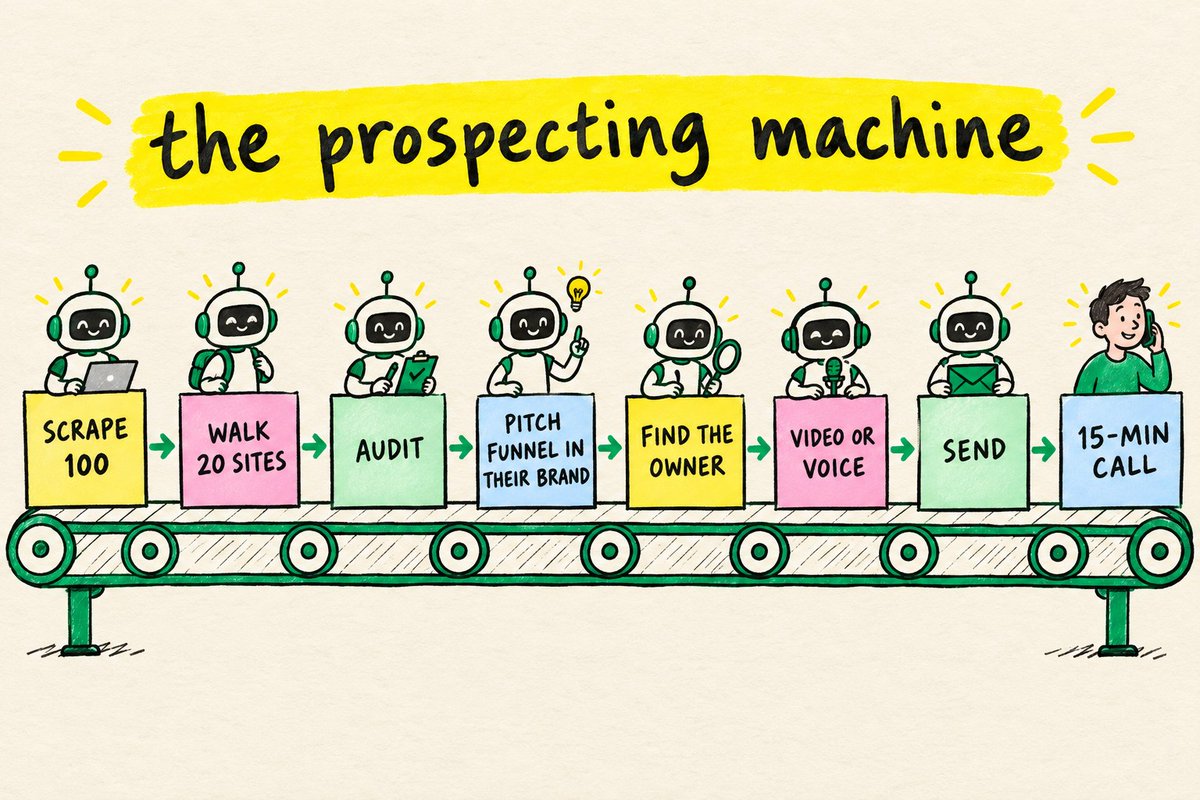
This is where it gets fun. Most agencies prospect by hand: a few cold emails a day, a generic deck, and a lot of waiting. With agents, you can research a hundred businesses, walk every one of their sites, and show up with a funnel already built in their brand.
Set up your desk
Everything runs from one folder. Open it in Claude Code, Codex or Cursor, and install the boringfunnels MCP so your agent can work from the whole library while it builds. The folder is the operating model: every niche and every client plugs into the same shape.
main-street-agency/
  START-HERE.md             what we sell, to whom, this month's focus
  niche/
    scorecard.md            the 6-line niche score
    customer-words.md       what buyers actually say (reviews, calls)
    offers.md               what we promise, and what we never promise
  prospects/
    charlotte-garage-floors.csv
    walks/                  browser agent notes + screenshots
    audits/                 worst-first leaks per business
    pitches/                funnel in their brand + video script
  clients/
    acme-coatings/
      brief.md
      funnel/               pages, emails, the ad
      monday.md             the five numbers, every week
  decisions/
    what-worked.md
    what-failed.md
Three files do most of the work. scorecard.md decides who you call. offers.md decides what you promise. what-failed.md stops you from paying for the same mistake twice. If you set up nothing else, set up those.
Step 1: Build the list
Pick one niche and one metro. Then pull every business in it: Google Maps (with a scraper like Apify or Outscraper, or have your agent write one), your state's licensing board, and the trade association directory. For each one you want the name, rating, review count, site, phone, and whether they're running ads (check the Google Ads Transparency Center and the Meta Ad Library).
Then have your agent rank them:
You're a sourcing analyst for an agency that builds funnels for [niche]
businesses in [metro]. From the attached list, keep businesses with 50+
reviews at 4.2 stars or better, an owner who still runs the business, and a
crew of roughly 2 to 20. For each one, note the site, whether they run Google
or Meta ads, the review count, and any sign they're growing (hiring, new
trucks, a second location). Rank them by fit. Mark every inference as an
inference.
Step 2: Walk every site like a customer
This is the step almost nobody does. Point a browser agent at each site, at phone size, and have it try to buy.
Open [site] at phone size. You're a homeowner with [problem] who wants a
price and a time. Time how long it takes to find the phone number and a way
to book. Note: Is there a clear offer? A price, or a priced first step? What
happens after the form (don't submit it)? Is there any reason to act this
week? Screenshot every screen. Then list what would stop you from booking,
worst first.
When I ran this on 11 local businesses, 9 had no way to capture an email, 8 had no priced first step, and 9 had a problem with the phone. Not one of them had a traffic problem. (You can do this in boringfunnels.com: the free audit brief has your agent walk the site and rank what it finds, worst first.)
Step 3: Audit, then build the pitch
The audit is your ammunition, never your pitch. Nobody wants a list of everything wrong with their business. They want to see it working better.
Two ways to do it with boringfunnels:
- Free. Open the boringfunnels library, find the funnel that fits their niche (Mr. Rooter, LeafFilter, Bay Crawl Space and dozens more local ones), and copy its brief into your agent. Or copy the audit brief: your agent lists up to eight things costing them customers, worst first, each with the fix, and changes nothing on their site.
- Pro. Point your agent at their site and have it build a pitch funnel in their brand: the pages, marked as a proposal, with nothing connected, and a link you can send. You walk in with the work, not a deck.
Step 4: Find the owner
License records and the BBB usually name the owner. For the email, I'd use treg. It puts the same data providers Clay uses (111 of them) behind one tool your agent can call, and you pay per result: about 2.5 cents for each email it finds, and nothing for a miss (treg). There's no table to build. Tell Claude Code or Codex to set up treg from treg.to/llms.txt, then have it find the owner, find the email, and verify it before you send anything.
Step 5: Scale yourself
A personal video gets replies. But you can't record a hundred of them a day. Two ways around that:
- A talking head. HeyGen's newest avatar model builds your avatar from a 15-second clip of you (HeyGen). Your agent writes a 45-second script for each prospect from the site walk and the pitch funnel.
- Your voice over their site. If the face still feels off, skip it. Clone your voice in ElevenLabs (plans from $6 to $22 a month, ElevenLabs) and lay it over a scrolling recording of their site and then the new funnel. It feels like a Loom, and nobody minds that it isn't a face.
The script prompt:
Write a 45-second script, in my voice, for [owner name] at [business].
Open with one specific thing I noticed on their site (from walks/[site].md).
Show the one change that would matter most, and what it looks like in the
pitch funnel. No jargon, no "AI". End with one ask: a 15-minute call to
walk through it. Under 110 words.
Two rules. Use your real voice and your real name, and label AI where the platform or the law asks you to. Never pretend you drove past their shop.
Step 6: Send
Use Smartlead or Instantly with separate sending domains, warmed up, at low daily volume. Keep it under 80 words with one ask and a link to their funnel or video. The average cold email gets a 3.43% reply rate, the top 10% of senders get over 10%, and 58% of replies come from the first email (Instantly, 2026 benchmark), so make the first one count. Include your address and an easy opt-out, and honor it.
Subject: your crawl space page

Hi [first name], I walked through [their site] on my phone the way a homeowner
would. Booking an inspection took me four taps and a form with no reply.

I rebuilt the page around a free inspection, in your brand, so you can see
it before anything changes: [link]

Worth a 15-minute look this week?

James
Step 7: The call
Open the funnel you built for them. Ask three questions: how many leads do you get a month, how many become jobs, and what is a job worth? Do the math together, out loud. Then offer the install.
Part 4: Deliver, then keep the client
Once they say yes, the build is the easy part. With boringfunnels Pro it starts with one prompt. Your agent shows you the funnels that fit and the one it recommends, what a booked job should cost on each, the plan, three looks and the page outline. You make those calls. Then it builds the pages, the emails and the ad in the client's brand, and a second reviewer checks every page on a phone and a computer before anything goes live.
Put a tracking ID on every link, every phone number and every ad, so you can connect the funnel to booked jobs. Then send the owner five numbers every Monday:
- Leads: calls, forms and texts.
- Booked jobs: appointments on the calendar.
- Cost per booked job: ad spend divided by booked jobs.
- Response time: minutes from a lead to the first reply.
- Revenue from booked jobs: or the close rate, if they won't share revenue.
If leads go up and booked jobs don't, the problem is the phone, not the funnel. Fix that first.

The math
Here's an illustrative example with round numbers. A roofer spends $9,000 a month on Google search ads. At $228 a lead (LocaliQ), that's about 40 leads. Say the current page and follow-up book 6 inspections, and a better funnel with a fast reply books 10. If they close a third of inspections, that's one or two extra roofs a month, at around $32,000 each (JLC, 2025).
That's the shape of the opportunity, not a promise. Every business is different, so use the owner's own numbers on the first call.

What breaks
This works, but not every time. Here's where I've seen it go wrong.
- Selling AI. The moment you say "AI automation," you sound like the last fifty pitches. Lead with booked jobs.
- Promising what you don't control. You build the funnel. They answer the phone. Write down who owns what before you start.
- Too many niches. One niche and one metro until it works. Your customer words, your proof and your funnels all compound inside one niche.
- Creepy outreach. AI video pretending to be a personal visit, scraped emails blasted at volume. It burns your domains and your name. Keep it honest and small.
- No tracking. If you can't connect your funnel to booked jobs, you're one slow month from getting cut.
- More leads than they can handle. A great funnel for a business that can't answer the phone makes everyone look bad. Fix the follow-up first.
- Believing the headline numbers. Plenty of the stats in this space come from vendors, including a few I quoted here. Underwrite every client on their own numbers.
If I were starting this week
- Monday: pick one niche and one metro with the scorecard.
- Tuesday: build a list of 100 businesses and rank them.
- Wednesday: have a browser agent walk the top 20 sites.
- Thursday: build three pitch funnels in their brands (you can do this in boringfunnels Pro).
- Friday: send 20 short emails, each with a video or a voice walkthrough.
- Next week: take the calls.
Everyone in the AI bubble is building apps for each other. Meanwhile the roofer, the septic guy and the garage floor company are paying $228 a lead to send people to a page that leaks. Find the boring industries. There's plenty to go around.
Want the funnels? Every week boringfunnels takes apart a real funnel that's working, from the ad to the last email, and turns it into a brief you can hand your coding agent. The free account gets you that week's study. Pro puts the whole library and a pro's method inside your agent, so it can build a client's funnel, or a pitch in their brand, from one prompt.